
Newsletter spring 2025
In Nairobi and across the 15 rural schools, we have a fantastic team of volunteers who invest a great deal of energy, hard work, and time into our project. Thanks to them, the Empowerment program has been such a success.
Our approach to combating menstrual poverty
All 50 mentors teach a total of 2,500 girls. Especially the 1,500 girls in rural areas benefit greatly from our Empowerment curriculum and our focus on issues surrounding menstruation and menstrual poverty. This topic is so important because there is still a lot of misunderstanding, and taboos around it can finally be broken. We receive a lot of positive feedback from schools, parents, and the wider community, who tell us that this knowledge—combined with the provision of sanitary pads and underwear—has truly changed the lives of vulnerable girls.
Through this approach, the community becomes more aware of menstruation and the importance of menstrual health. We also hear that girls who follow our program are no longer victims of sexual abuse in exchange for sanitary pads. This is a major issue that often occurs in poor rural areas when girls have no access to menstrual products.
Sanitary pads – a sustainable solution
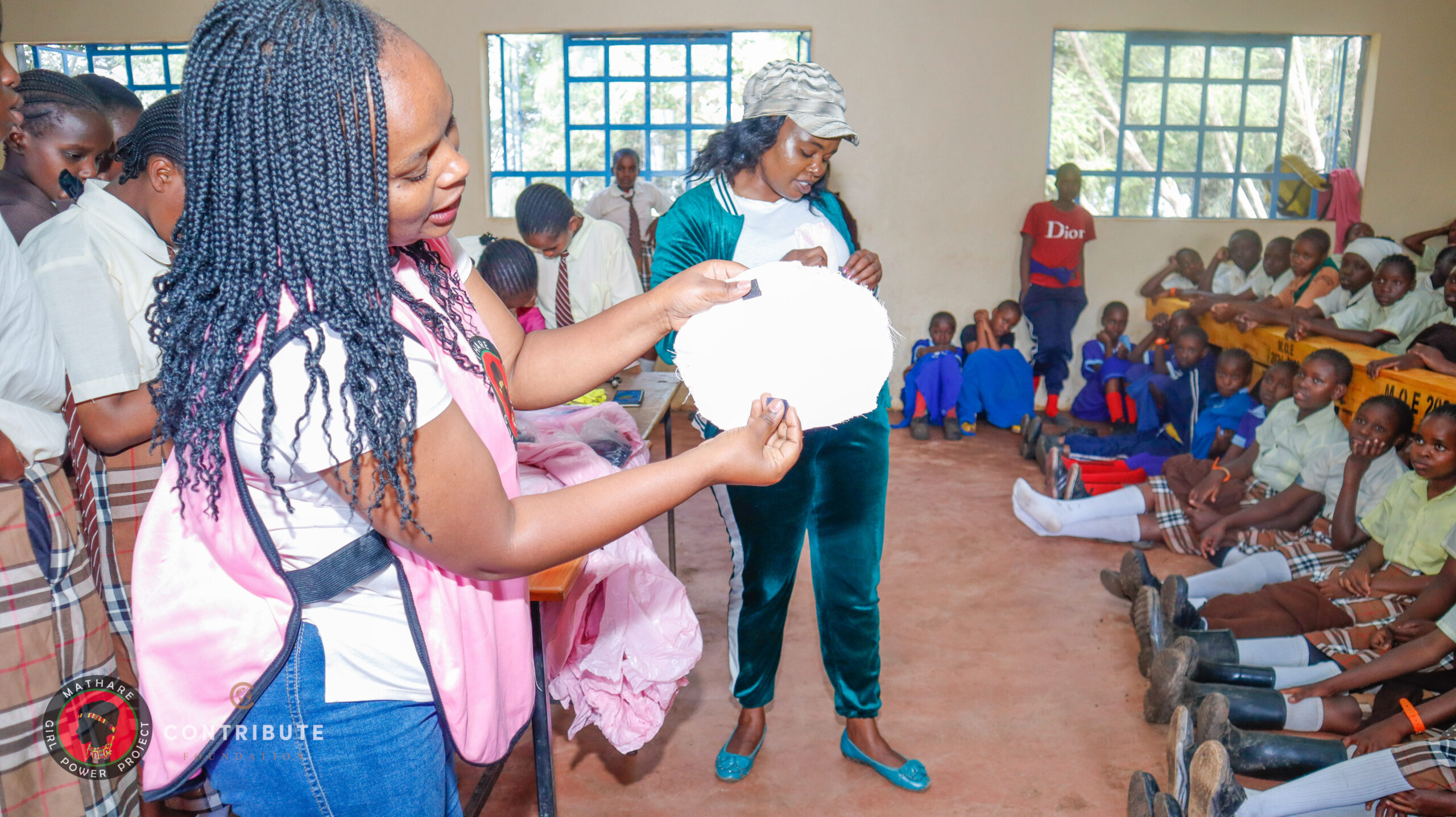
Sewing your own sanitary pads that can be used over long periods, are washable, and do not lead to environmental pollution—this is a solution we are going to introduce.
All girls participating in our program will receive sewing lessons and learn to hand-sew their own sanitary pads.
This is a new skill, and it is encouraged by the government, although the government does not provide funding to schools to make this possible. Thanks to the support of Stichting Contribute, we have been able to make a start. We hope to raise enough funds each year to continue this.
The first lessons have started, and everyone is very enthusiastic. The girls have never done anything like this before, as they do not receive creative lessons at school, and it truly requires practice to achieve the desired result.
We will share more about this in the next newsletter.
Two-day training for mentors in Nairobi
All 50 mentors (from Nairobi and the outreach schools) participated in a two-day training. The training focused on orienting new mentors (15) and reintroducing the program to those who had changed schools. In Kenya, teachers are regularly transferred to other schools by government assignment.
- All mentors received training in mentorship skills and evaluated the program to improve it where necessary.
- We focused on sustainability and discussed how our program can achieve a sustainable future, including opportunities to produce school uniforms in the future to generate income for the project.
- All mentors learned a new skill: sewing washable, reusable sanitary pads, which was met with great enthusiasm and appreciation.
- The gathering provided valuable team building and was a positive step for the entire team.
- The new sewing skills will be taught to the students, who in the coming months will learn to make their own sanitary pads.
Call to action – A new laptop for Michael
Thanks to Michael, we always receive fantastic photos and video reports from Nairobi. He travels to all our rural schools to capture photos and videos of activities, interviews, and workshops, so we can clearly show what we do. He is an important member of our team and truly indispensable to our project.
A few years ago, I was able to give him a second-hand laptop from the Netherlands, which he has used extensively, but it is now completely broken. He urgently needs a new second-hand laptop. In Nairobi, they cost about the same as they do here.
For €500, he can purchase a good second-hand laptop there.
Would you please consider helping us with a donation for this laptop?